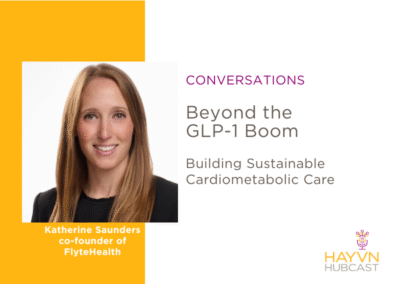
In this episode of the HAYVN Hubcast, Nancy Sheed welcomes back Katherine Saunders, co-founder of FlyteHealth, for a powerful conversation on the evolution of obesity and cardiometabolic care.
Since her last appearance—when her company was still in its early stages under the name IntelliHealth—Katherine has led a transformation from a software-focused startup into a comprehensive virtual clinical care provider. Now rebranded as FlyteHealth, the company delivers integrated cardio-kidney-metabolic care directly to patients, while partnering with employers to reduce healthcare costs and improve outcomes.
Katherine explains how the rise of GLP-1 medications like Wegovy, Ozempic, and Zepbound changed the national conversation around obesity. But she cautions against the current “GLP-1-only” mindset, emphasizing that true success requires comprehensive medical evaluation, personalized treatment plans, and ongoing support—not just a prescription.
The discussion explores:
Why obesity medicine was historically overlooked in medical training
How GLP-1 demand has reshaped employer healthcare strategies
The financial strain these medications place on self-insured employers
The importance of care navigation and communication between specialists
How technology can enhance—not replace—the provider-patient relationship
FlyteHealth’s model blends advanced clinical decision support tools with human-centered care, allowing providers to practice at the top of their training while delivering better outcomes for patients and better ROI for employers.
Key Highlights
From Software to Full-Service Clinical Care FlyteHealth began as a tech platform to scale obesity treatment but evolved into a direct care provider when it became clear that technology alone wasn’t enough.
The GLP-1 Explosion — and Its Limits While GLP-1 medications have revolutionized obesity treatment, Katherine stresses that medication without comprehensive care leads to poor outcomes and rising costs.
The Employer Healthcare Dilemma Self-insured employers face skyrocketing costs for GLP-1 medications. FlyteHealth offers a structured, outcomes-focused program that balances access with cost control.
Obesity as a Root Disease Treating obesity improves or prevents over 200 related conditions, including hypertension, prediabetes, and cholesterol issues—making integrated care essential.
Technology as a Support System, Not a Substitute Clinical decision support tools gather and analyze data before visits, allowing providers to spend more time educating and connecting with patients.
This conversation highlights a pivotal moment in healthcare. The excitement around GLP-1 medications has brought long-overdue attention to obesity as a serious medical condition—but as Katherine makes clear, prescriptions alone are not the solution. Sustainable results require comprehensive care, personalized treatment, coordinated communication, and smart use of technology.
FlyteHealth represents a model for where healthcare is heading: integrated, data-informed, and human-centered. As employer-sponsored healthcare continues to evolve and new therapies enter the market, thoughtful systems like this may be what keeps care both effective and financially sustainable.